
Dueling Part 2
Melee dueling for D20 Systems

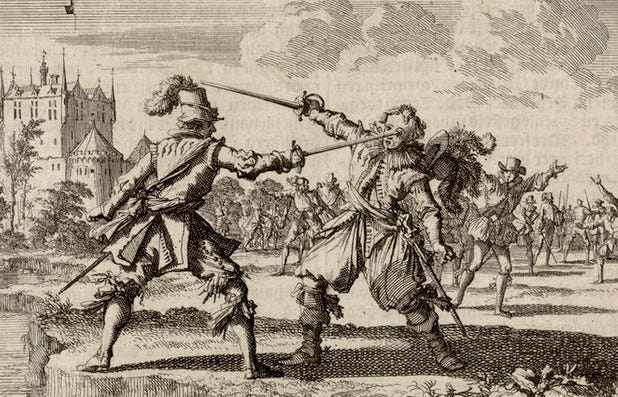
In my last article, I began a discussion of dueling in RPGs by introducing some mechanics for pistol dueling. Now I have a much more arduous task in front of me; melee dueling. As I said in the last article, the level of abstraction of combat needs to correlate with the scale of the combat. A skirmish between two small groups of combatants requires a different level of detail than a massive battle or a one-on-one duel. When I spoke with my friend AlchemicRaker about The Old Lords of Wonder and Ruin, he talked about how Chainmail handles this shift in scale from dungeon combat to mass combat using the 10-to-1 rule. In order to make melee dueling strategically satisfying, we need to look at removing layers of abstraction. To do this, we should look at the contexts in which this kind of combat would be relevant.
Much like pistol dueling, melee dueling has a long historical precedent. In fact, melee dueling has an even longer history dating back to tribal combat and judicial duels. I won’t go into too many details on these, but both were trials by combat that helped resolve legal issues from ownership to the resolution of crimes that had no witnesses. These judicial duels evolved into the kind of honor dueling that you see in movies and then eventually into combat sports like competitive boxing and wrestling. While empty-hand martial arts have existed since the dawn of time, codified rules like Broughton, London Prize Ring, and Marquess of Queensberry Rules were specifically developed as a non-lethal means of settling honor duels. In the context of fantasy, you’ll also have climactic duels between two rivals with major consequences hanging in the balance. The Duel of the Fates in The Phantom Menace springs readily to mind along with Robin Hood’s duel with Sir Guy of Gisborne. Your players may find themselves dueling with NPC rivals or even each other in honor duels, judicial duels, or in the heat of battle. Each of these circumstances will impart different complications onto the duel and will have their own variations. Still, we must create a central formula upon which we can iterate.
As with pistol dueling, we are starting with the basic D20 mechanic. Normally, an attack is compared against armor class to determine a hit and then damage is rolled. However, we’re going to use an opposed roll to represent active defense. This turns every attack into a roll-off with control over the bout on the line. Instead of AC creating a target number or affecting a hit matrix, AC will act as a buff to the defender’s roll in systems with ascending armor class or a de-buff to the attacker’s roll in system’s with descending armor class. All attacks are treated the same way as in normal combat; roll and add the appropriate modifiers. Defense is a roll using Strength to parry or Dexterity to evade. A successful strike deals damage, but a successful defense may grant an opportunity to counter-attack. To further illustrate, we should look at how a round goes.
Step 1: Initiative
Initiative will be handled like it was in Part 1. Roll initiative using whatever system your game uses, but the loser declares their action first. Then the winner declares their action, and their action will happen first. Possible actions include attacks, but also grappling, taking a defensive posture, and repositioning. Grappling includes hooking a weapon or shield for a disarm, going for a takedown, tripping, or entangling an opponent. This works like a standard attack with an opposed strength roll. Winning allows you to do the action you were attempting. Taking a defensive posture is preparing for an incoming attack which grants a +5 bonus to your Defense roll. Repositioning is an opposed Dexterity-based roll to position yourself behind or on the flank of an opponent. This grants a +5 bonus to the next attack and a +5 bonus to any defense that round if successful.
Step 2: Actions
As with Part 1, actions play out in reverse order from declaration. What this means is that the initiative winner’s action is likely to disrupt the action of his opponent. Many of these actions directly counter the standard action of attacking. The possibility of countering an attack gives more strategic options which will break the cycle of “I attack” repeated ad nauseam. You could attack this round, or you could reposition to give yourself more of an advantage next round. You could trip or disarm to make your next attack easier and your opponent’s next attack harder. The possibility of disrupting an action changes the dynamic of the duel so that it doesn’t devolve into hitting each other until the numbers go down. Still, attacking will be a majority of the actions taken in a duel. As stated at the beginning of the article, this will be an opposed roll between the attacker and the defender. The attacker adds their attack modifiers to the roll and the defender adds their AC along with strength modifiers for a parry defense or dexterity modifiers for a dodge. Weapons with the Heavy property can only be parried by other heavy weapons. If the attacker wins, he rolls damage, if the defender wins, a number of things can happen which will be explained in the next section.
Step 3: Resolution
Once action rolls are made, the results must be applied. As I mentioned in the last section, a successful attack grants normal weapon damage. A successful defense has three possible outcomes. If the defender is successful by less than 5 over their opponent’s roll, the attack is either parried or evaded. If they win by 5 or more, their opponent is off balance and they have a +5 to their attack next round. If the defender wins by ten or more, they get an immediate counter attack. Once that is resolved, apply damage and roll initiative for the next round. The duel will continue until one party yields, one party is unable to continue or one party is dead.
This is my rough prototype for how a melee duel would function in a D20 system. Part of why this has taken so long to write was that it inspired me to begin my journey on Project Skeleton, a new RPG system that I have recently begun working on. I hope to refine this idea further and I will likely revisit this topic down the road. Until next time, thank you for reading.